પસંદ કરેલી કૃતિ · selected work
આ શેરી વળાવી
I Have Swept This Street Clean (Come Home, My Love)
Narsinh Mehta, Adi Kavi · c. 1450
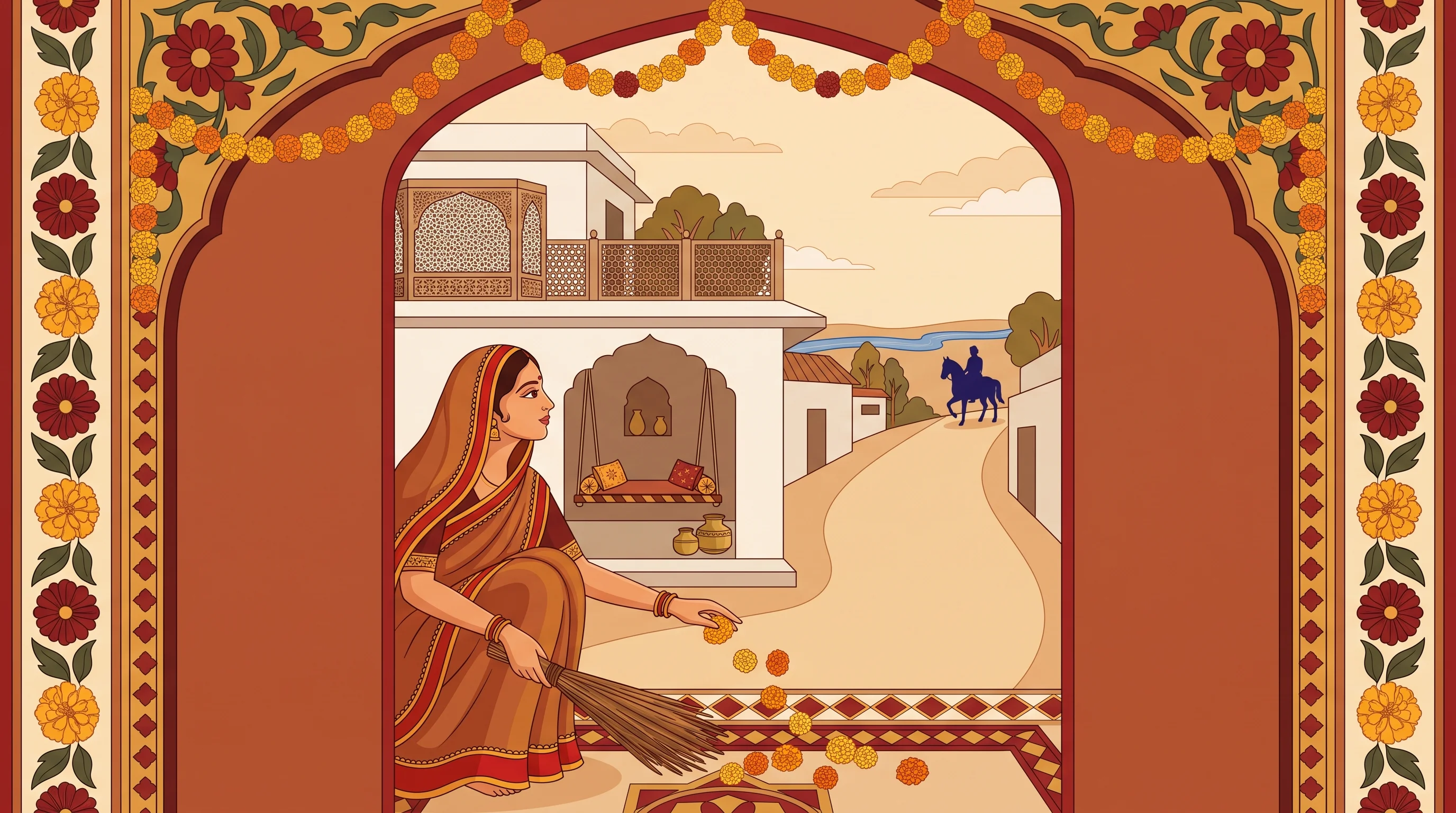
આ શેરી વળાવી સજ્જ કરું, ઘરે આવો ને!
આંગણિયે પથરાવું ફૂલ, વાલમ ઘરે આવો ને.
આ ઉતારા દેશું ઓરડા, ઘરે આવો ને;
દેશું દેશું મેડીના મોલ, મારે ઘરે આવો ને.
આ દાતણ દેશું દાડમી, ઘરે આવો ને;
દેશું દેશું કણેરી કાંબ, મારે ઘરે આવો ને.
આ નાવણ દેશું કુંડિયું, ઘરે આવો ને;
દેશું દેશું જમનાજીનાં નીર, મારે ઘરે આવો ને.
આ ભોજન દેશું લાપશી, ઘરે આવો ને;
દેશું દેશું સાકરિયો કંસાર, મારે ઘરે આવો ને.
આ રમત દેશું સોગઠી, ઘરે આવો ને;
દેશું દેશું પાસાની જોડ, મારે ઘરે આવો ને.
આ પોઢણ દેશું ઢોલિયા, ઘરે આવો ને;
દેશું દેશું હિંડોળા ખાટ, મારે ઘરે આવો ને.
આ મહેતા નરસૈંયાના સ્વામી શામળિયા, ઘરે આવો ને.
This is a song of invitation — an aavahan — from the founder of the Gujarati poetic tradition. Narsinh Mehta, revered as the Adi Kavi (the first poet), wrote in the ecstatic register of Krishna devotion roughly a century before Mira and the northern sant poets rose to fame. Here he speaks not in his own voice but through the viraha longing of a bride or gopi who has readied her whole household for a guest who has not yet arrived. The very first act — 'આ શેરી વળાવી', having swept the lane clean — is telling: hospitality does not begin at the door but out in the public street, and 'આંગણિયે પથરાવું ફૂલ' (I strew flowers across the courtyard) completes the preparation of the approach itself.
What follows is a beautifully patterned catalogue. Each couplet names one domain of welcome and then doubles the offering: lodging becomes rooms and then 'મેડીના મોલ' (upper-storey mansions); the morning twig becomes a pomegranate stick and then an 'કણેરી કાંબ' (oleander switch); a bath becomes water pots and then, tellingly, 'જમનાજીનાં નીર' — the waters of the Yamuna. That single escalation from ordinary well-water to the sacred river quietly unmasks the guest: only Krishna's home is the Yamuna, and only for him would a household offer its waters. The catalogue moves on through food ('લાપશી' and 'સાકરિયો કંસાર', sweet cracked-wheat dishes), games ('સોગઠી' and 'પાસાની જોડ', dice and pachisi), and rest ('ઢોલિયા' and 'હિંડોળા ખાટ', a cot and a swing-bed). Binding it all is the soft, coaxing imperative that lands at the end of every line — 'ઘરે આવો ને' — so that the poem becomes one continuous act of longing: everything a home can give is offered, and the only thing missing is the beloved's presence.
Read devotionally, the swept street and the flower-strewn courtyard are the readied heart of the bhakta, and every doubled offering is the soul's preparation to receive divine grace. The poem closes, as Narsinh's poems do, with his signature bhanita — 'આ મહેતા નરસૈંયાના સ્વામી શામળિયા' — naming himself and his lord Shamaliyo, the dark-hued Krishna, and folding an intimate household song into his lifelong devotion. As a fifteenth-century oral composition it has no fixed critical text, and its stanzas and spellings vary slightly across anthologies, yet the poem has lived unbroken as a beloved Gujarati bhajan, sung at devotional gatherings and in wedding-adjacent settings for the tenderness of its central image: a home adorned in full, waiting for the one who completes it.
નરસિંહ મહેતા
Narsinh Mehta, revered as the *Adi Kavi* (First Poet) of Gujarati literature, was a 15th-century poet-saint whose devotional verses defined the bhakti tradition in Gujarat. Born into a Nagar Brahmin family in Junagadh, his life became legend — stories of his unwavering devotion to Krishna, his defiance of caste conventions, and his miraculous encounters became inseparable from his poetry. His most famous work, *Vaishnav Jan To*, became Mahatma Gandhi's favourite hymn and an anthem of the Indian independence movement five centuries after it was written.
All poems by Narsinh Mehta →